
BUGS, SPIDERS & MICE—OH MY! A RENTER’S GUIDE TO FALL PESTS IN GREAT FALLS
Jerrica Seilstad, LPM, RPM Candidate
September 2026
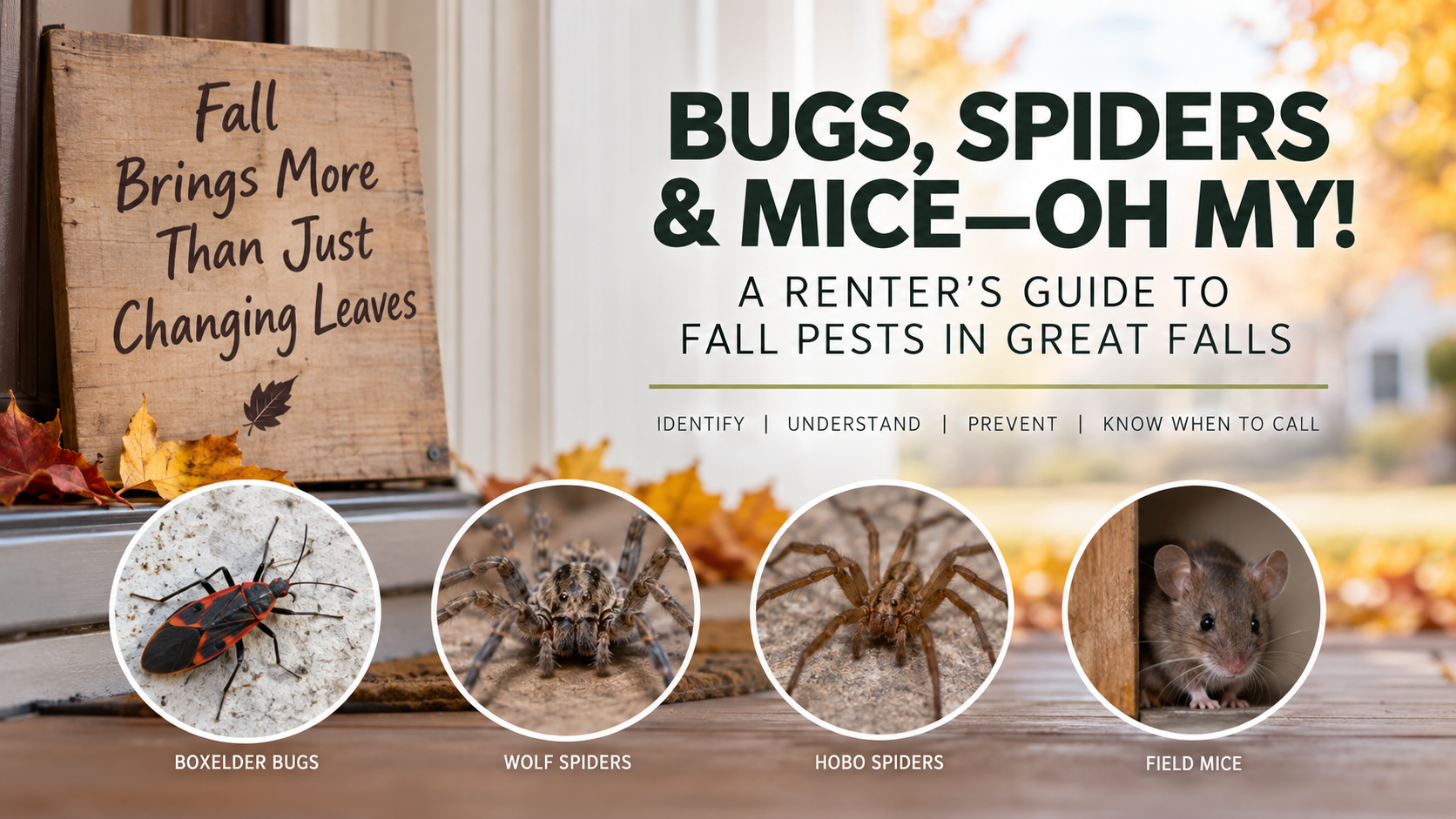
As summer turns to fall in Great Falls, we aren't the only ones noticing the cooler nights. Boxelder bugs begin gathering on sunny walls. Spiders seem to suddenly appear in basements, garages and bathrooms. And as temperatures continue to fall, mice and other small critters begin looking for warmer places to spend the winter. Finding a bug or spider inside your home can certainly be unpleasant, but it doesn't necessarily mean there is an infestation—or that something is wrong with the home.
In fact, Montana State University Extension notes that an increase in insects and spiders entering homes during the fall is normal. Most are nuisance visitors seeking shelter rather than pests reproducing inside the home.
The goal isn't necessarily to make a home completely pest-free. That's rarely realistic. Instead, good pest management focuses on preventing entry, removing food and shelter, monitoring activity, and recognizing when normal seasonal visitors have crossed the line into an actual pest problem.
MEET SOME OF OUR COMMON FALL VISITORS
Boxelder bugs are approximately ½ inch long and are easy to recognize by their black bodies with distinctive reddish-orange markings. Late summer and fall are prime boxelder bug season. They frequently congregate in large numbers on warm, sunny south- and west-facing exterior walls before finding protected places to overwinter.
And when we say large numbers, we mean it.
I, myself, can personally attest to this one. My backyard is full of boxelder trees—the very trees these bugs are named for because they're an important host for boxelder bugs. In other words, my family lives in what might be considered prime boxelder bug real estate.
For about two weeks at the end of summer and beginning of fall, the annual boxelder convention descendsupon our house. There can be so many gathered around the front of the house that the my family essentially admits defeat, abandons the front door, and walks all the way around the house to use the back door instead. All the while, getting dive bombed along the way. It's less "walking around to the back door" and more "running a tiny, harmless insect gauntlet."
Is it annoying? Absolutely.
Does it mean the house is dirty, poorly maintained, or infested? Not at all. Sometimes your backyard is simply full of boxelder trees and the boxelder bugs have correctly identified your address as the place to be.
The good news? They're primarily a nuisance and there aren't nearly as many Boxelder trees inside Great Falls city limits so numbers of Boxelder bugs aren't quite as bad as my out-of-city-limits home. MSU Extension describes boxelder bugs as harmless to people, pets and structures. The bottom line? Hang in there! You are not alone in your frustrations with those darn little pests. Before you go stomping and squishing them, you should know that they can stain light-colored materials and produce an odor when crushed. Check out the MSU Extension factsheet to learn more...
So if you find several boxelder bugs hanging around a sunny window or door during September or October, don't panic. Keep an eye on the activity, remove the ones that wander inside, and remember:
Sometimes a bug is just a bug. And sometimes it's 10,000 bugs that have collectively decided your front door belongs to them for two weeks.
Wolf spiders can be startling because some Montana species become quite large. They're generally brown, gray or dark colored and are fast-moving hunters. Unlike spiders that build webs to catch prey, wolf spiders actively hunt insects. They're common throughout Montana and may wander indoors, particularly as conditions outside change. MSU Extension considers wolf spiders harmless and beneficial predators.
One especially distinctive characteristic is the female's parenting behavior: she carries her egg sac with her and, after the babies hatch, may carry dozens of tiny spiderlings on her back. It can be quite a sight—but it is normal wolf-spider behavior. Check out the MSU Extension factsheet to learn more...
Hobo spiders have developed a frightening reputation over the years, but some of that reputation isn't supported by current research. Hobo spiders have long been present in Montana, and MSU Extension specifically notes that it is normal for them—and other spiders—to enter buildings during late summer and early fall. They aren't considered naturally aggressive, and there is no conclusive evidence that hobo spider venom causes the severe necrotic wounds historically attributed to them.
They're also notoriously difficult for the average person to identify by appearance alone. If identifying a spider matters, an expert identification is much more reliable than comparing it with pictures found online. One important exception in Montana is the black widow, which MSU Extension identifies as Montana's spider of medical concern. Brown recluse spiders, despite frequently being blamed for bites, are not established in Montana. Check out the MSU Extension Factsheet to learn more...
A BUG IN THE HOUSE DOESN'T NECESSARILY MEAN A PEST PROBLEM
Even an exceptionally clean, well-maintained home isn't an airtight bubble. Doors open. Screens develop small gaps. Utility lines penetrate walls. Foundations have tiny openings. Groceries, packages, firewood and belongings come inside. Insects live in lawns and landscaping immediately outside our homes. That's why pest presence and pest infestation aren't necessarily the same thing.
Seeing an occasional spider, fly, boxelder bug, ant or other outdoor insect—particularly during seasonal transitions—is generally part of living in Montana.
We become more concerned when residents are seeing things such as:
- large or increasing numbers over an extended period;
- repeated activity concentrated in the same interior area;
- evidence that pests may be reproducing inside;
- unexplained property damage;
- rodent droppings, nesting material, gnaw marks or food damage; or
- repeated mouse sightings or noises inside walls.
When in doubt, document what you're seeing. A clear photograph and information about where, when and how frequently you're finding the pest can be much more useful than simply reporting "there are bugs."
START SIMPLE: PREVENTION IS OFTEN THE BEST PEST CONTROL
Before reaching for pesticides, there are several inexpensive steps that can make a substantial difference. Vacuuming is one of the easiest ways to remove spiders, webs and nuisance insects indoors. Boxelder bugs can also be vacuumed rather than crushed, which helps avoid staining. Keep floors, countertops and cabinets free of crumbs and food residue. Wipe spills promptly. Don't leave dirty dishes or open food sitting overnight. Store pantry foods, pet food and bird seed in secure containers. Take garbage out regularly and keep trash containers closed.
Reduce clutter, particularly cardboard boxes and seldom-disturbed piles in basements, garages and storage areas.
Check screens and keep exterior doors closed when they're not being used. Residents of single-family homes can also look for obvious gaps around doors, utility penetrations and other possible entry points. Outside, keep leaves, debris, excessive vegetation, stacked materials and firewood away from the foundation when possible. These provide excellent hiding places for insects, spiders and rodents.
WHAT ABOUT DIY PEST CONTROL?
For occasional nuisance pests, mechanical controls are often a good first choice: vacuuming, sweeping, removing webs, sealing appropriate entry points, and using commercially available insect or spider monitoring traps according to their instructions.
There are also many over-the-counter pest-control products available to consumers. However, more pesticide does not mean better pest control.
If you choose to use any pesticide product, always read and follow the complete product label, including where the product may be used, application instructions, required precautions, ventilation requirements, storage instructions, and restrictions involving children or pets. Never use a product in a location or manner that isn't permitted by its label.
For renters, there is another consideration: please don't perform structural alterations or attempt extensive chemical pest treatments without first contacting property management. If you believe you have an infestation rather than ordinary seasonal pest activity, let us know so the situation can be properly evaluated.
Don't Forget! You have a Resident Benefit Package that provides you with a pest control kit at no extra charge. All you have to do is claim it. Visit your RBP portal to claim.
NOT SURE WHAT YOU FOUND? ASK THE EXPERTS!
Here's one of Montana's best-kept homeowner—and renter—resources.
Montana State University Extension provides research-based information on insects, spiders, rodents, plants, home horticulture and many other issues. Here in Great Falls, residents can contact:
MSU Extension – Cascade County
3300 3rd Street NE, #9
Great Falls, MT 59404
406-454-6980
For more difficult identifications, MSU's Schutter Diagnostic Lab in Bozeman identifies insects and other arthropods and can provide management recommendations. Routine identification is generally free for Montana residents, subject to the lab's submission policies. You can even begin with photographs. The lab accepts digital submissions and will request a physical specimen when necessary. If you're asked to mail an insect specimen, follow the lab's current instructions carefully. The lab requests several specimens when possible and a sturdy, tightly closed container. Spiders, mites, small flies and larvae are submitted in rubbing alcohol, while hard-bodied insects generally don't require it. Complete the lab's Insect Identification Submission Form and include information about where and when the specimen was collected.
Samples can be mailed to:
Schutter Diagnostic Lab
Montana State University
119 Plant BioScience Bldg.
P.O. Box 173150
Bozeman, MT 59717-3150
406-994-5150
diagnostics@montana.edu
That's a much better way to answer "What in the world is THAT?" than relying on a social-media comment section!
AND THEN THERE ARE MICE...
As Montana temperatures drop, mice begin seeking food and protected places—and it doesn't take much of an opening to let one inside.
MSU Extension reports that mice can enter through openings as small as approximately ¼ inch. That means mouse prevention isn't simply a matter of keeping a clean house. Sanitation is important because it reduces available food and shelter, but exclusion—preventing mice from getting inside—is equally important.
FOR RENTERS IN SINGLE-FAMILY HOMES
Fall is a great time to take a walk around the property.
Look for obvious gaps around doors, garage doors, pipes, vents, utility penetrations and the foundation. Check that exterior doors close properly. Keep vegetation and debris away from the foundation where practical, and avoid stacking firewood, cardboard or other materials directly against the house. MSU Extension recommends creating an open area approximately two to three feet wide around exterior walls where possible because wood, cardboard, vegetation and debris provide rodents with hiding and nesting areas. Visit MSU Extension here to learn more...
Inside, keep food—including pet food and bird seed—in tightly closed containers. Clean up crumbs and spills promptly and avoid leaving pet food out overnight. If you discover an opening that appears to require a building repair, report it to JK Property Management via a maintenance request through your tenant portal rather than making structural repairs yourself.
FOR APARTMENT & MULTI-FAMILY RESIDENTS
You may have less control over the exterior of your building, but what happens inside your apartment still matters.
Keep food securely stored, clean crumbs and spills promptly, dispose of garbage regularly, reduce clutter, and avoid leaving pet food accessible overnight. Most importantly, report evidence of rodents promptly.
In a multi-family property, pest activity can involve more than one unit or a shared building area. Early reporting gives property management an opportunity to evaluate the larger situation rather than treating an individual sighting in isolation.
IF YOU FIND EVIDENCE OF MICE
Droppings, gnaw marks, damaged food packaging, nesting material or repeated sightings deserve attention.
Residents should also use appropriate precautions when cleaning areas contaminated by rodents. Don't simply sweep or vacuum rodent droppings without first reviewing current public-health guidance for safe cleanup. MSU Extension specifically references the CDC/DPHHS approach to rodent problems as "seal up, trap up and clean up."
If you're a JKRPM resident and believe mice are entering through a maintenance-related opening or you're seeing continuing rodent activity, submit a maintenance request so we can evaluate the situation.
A LITTLE PERSPECTIVE GOES A LONG WAY
Sharing our homes with bugs isn't anyone's favorite part of Montana living.
But an occasional spider in the basement, a handful of boxelder bugs around a sunny window, or another outdoor insect wandering through the door doesn't necessarily indicate a dirty home, a poorly maintained property or an infestation.
A clean and well-maintained home can reduce pest activity, but it cannot guarantee that you'll never encounter a bug, spider or mouse.
Our best defense is a combination of good housekeeping, removing food and hiding places, preventing entry wherever practical, monitoring activity and addressing developing problems early. And when you're staring at an eight-legged visitor wondering exactly what you're looking at? Don't guess. Montana State University Extension has experts for that.